New York Times Article - Taking the House for a Spin
February 10, 2004
By STEVE DOUGHERTY
Published: February 6, 2004
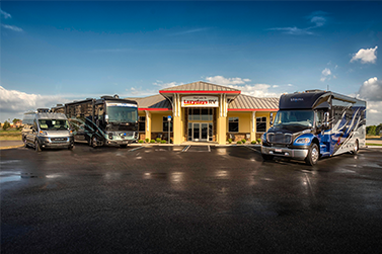
I am white-knuckling it at the wheel of a big rig — an American Coach Eagle diesel pusher — maneuvering the behemoth Class A recreational vehicle between Spanish-moss-adorned live oaks that shade the outdoor showroom at the Lazydays® R.V. SuperCenter® just outside Tampa, Fla. It isn't the Greyhound-size super coach's 500-cubic-inch rear-mounted diesel engine that has put the fear in me, but the monster price tag: $450,000.
Forty-two feet from bow to stern and 11 1/2 feet wide with its triple slide-outs extended, with 8-foot ceilings and deluxe wood-finish interiors, this R.V. has more living space than my last Manhattan apartment. And it is tricked out with more than $100,000 in options, including a satellite dish on the roof, flat-screen TV's, computer hookups and a surround-sound component stereo system that puts my own modest home system to shame.
Riding as high as a trucker, I sit on the cushy leather-upholstered captain's chair that would be the envy of past generations of backache-plagued Teamsters. With the slide-outs retracted, the bus is a not-so-svelte 8 1/2 feet wide. After disengaging the hydraulic lifts that level the coach when at rest on uneven ground, releasing the air brakes and putting the fully automatic rig in gear — all with the push of a few buttons — I could easily turn the big black steering wheel with one finger. Instead, I grip it as tightly as a lifeline, knowing that repairs for the tiniest bender on the high-priced fender start at $1,000 in one of Lazydays' service bays.
A 155-acre complex of office buildings, showrooms, hangar-size garages, sales lots and campsites, Lazydays® is the country's largest recreational vehicle dealership. It has more than 1,200 new and used units on display, attracting R.V. enthusiasts and greenhorns like me eager to get behind the wheel of one of the most popular big-ticket toys on the market today. Lazydays® did an impressive $750 million in business last year, selling, trading and maintaining R.V.'s that range from humble pop-top camper vans to $500,000 45-footers built on converted bus chassis, and accounted for more than six percent of all new R.V.'s sold in the United States in 2003, according to the Recreational Vehicle Industry Association in Reston, Va.
"It feels unnatural at first," says Snow Chambers, 58, one of the center's sunny tour guides and a longtime driving instructor, as I begin a right turn, a maneuver that's much more daunting than it sounds. "Actually," I reply as I roll the rig into the middle of the intersection, careful to align the center line with my knees before cutting the wheel, "I feel like I'm being pushed off the edge of a cliff."
Mr. Chambers, who acquired his nickname when he moved to Tampa from New Jersey as a teenager in the 1960's and was labeled a snowbird, assures me that "it takes some getting used to, but once you get the hang of it, it's just like driving a car." Only one worth a cool half million.
"You've got to forget what's behind you," is the Zen-like driving tip offered by Ernest Kirkpatrick, 58, a veteran R.V. pilot. "It's what's out in front that counts." A retired contractor, Mr. Kirkpatrick owns a stationary home in Conyers, Ga., with his wife, Peggy, but they live in their 40-foot Holiday Rambler six to seven months a year.
"It's our house on wheels," says Mrs. Kirkpatrick, 57. "It's no different than driving an automobile, except you have longer stopping distances. And you have to watch out for cars — a lot of people hate driving behind us, so they pass, then slow down as soon as they get in front of us. Over the years, we've grown a lot more appreciative of truckers. They're by far the most considerate drivers on the road."
Now making their annual winter drive from Georgia to Fort Myers Beach, on Florida's southwest coast, the Kirkpatricks have stopped for the night at the campground at Lazydays. R.V.'ers can park and plug in for the night. R.V. manufacturers frequently hold elaborate rallies to show off new product lines and participants dine in a banquet hall, swim in a heated pool and are offered performances by Elvis, Patsy Cline and even Liberace impersonators. "It's like a giant ongoing tailgate party," Mr. Chambers says of the campground and its constantly changing and convivial visitors.
The Kirkpatricks first came to Lazydays® in 1997 when they bought their Rambler new for $140,000. "We never had R.V.'d," says Mrs. Kirkpatrick, who like everyone I talk to at Lazydays® uses the universally accepted abbreviation as a verb. "We were completely green, but we did our homework."
The purchase quickly brought out the wanderlust in the Kirkpatricks. "We just fell in love with the lifestyle," says Mrs. Kirkpatrick, who refers to fellow R.V.'ers and Lazydays® staffers like Mr. Chambers as "part of the family, our family."
"That's what R.V.'ing is all about," Mr. Kirkpatrick adds. "There's a real camaraderie." Having driven in every state in the contiguous United States except Vermont and Delaware — "No reason, just haven't made it there yet," he says — the couple often make treks in caravans of up to 20 R.V.'s. Like other owners of Class A rigs — the same classification as my ride for the day, the American Coach Eagle — the Kirkpatricks find that many campgrounds cannot accommodate the newer super-size coaches. "They're not modern enough," Mr. Kirkpatrick says. "They're built for World War II folks."
That's R.V. shorthand for the earlier generation of retirees who took to the road in the 1960's and 70's in smaller campers and so-called tow-behinds — trailers to non-R.V.'ers — that most motor campgrounds were designed to accommodate.
"The pads are too short and too close together," Mrs. Kirkpatrick says, "so you can't use your slide-outs" — those retractable mini-additions that, at the push of a button, add elbow room to the bedroom and dining areas and up to three feet to the bus's total width. And, she adds, they don't have the hookups necessary to meet the big air-conditioned coaches' need for 50-amp power.
As a result, experienced R.V.'ers like the Kirkpatricks often park at Wal-Marts, taking advantage of the stores' vast paved parking lots and generosity. "They let R.V.'ers park for free," says Mrs. Kirkpatrick, whose coach, like most larger R.V.'s, has a generator and sizable built-in tanks for water and waste. "But the reality is we pay. It's hard to go to a Wal-Mart and not buy something."
After relocating after 20 years at a much smaller site within Tampa city limits in 1996, Lazydays® is now just west of the city off Interstate 4 and employs 150 sales people, who greet customers at the door and tell them they are welcome either to take a tour with a sales agent or go it alone. All of the vehicles are unlocked and open for inspection.
Boarding a 1997 Country Coach Prevost, a silver 45-foot bus conversion that's offered at $429,000, I meet Brad Hubbard, a good-humored 69-year-old retired Texas Department of Transportation worker from Round Rock, near Austin, who speaks in a mellifluous Willie Nelson drawl. He and his wife, Betty, who logged 13,000 miles and used an estimated 1,200 gallons of diesel fuel on a two-month drive to Alaska last year, are trading in their old Safari R.V., a Class A beauty with a large airbrushed painting of a pair of entwined monkeys on the back — "Those love monkeys sure do get attention on the highway," Mrs. Hubbard says — for a newer Country Coach.
Barbecue aficionados, the couple says R.V.'s have allowed them to take their love for hot pepper sauces to a new level. "We judge chili contests, fish cook-offs, barbecues," Mr. Hubbard says. The couple's dream drive? A hot-pepper pilgrimage from the Tabasco Pepper Sauce factory in Avery Island, La., to the Texas International Championship Chili Cook-Off, held annually on the first Saturday of November in Terlingua, Tex.
Inviting me back to their Safari, Mr. Hubbard ladles me a cup of chunky homemade chili that has been percolating in an electric frying pan outside the coach. (It's delicious.) I'm about to ask him if he gets paid for judging chili contests. But by the way he digs into his own cup, I know that chili judging is its own reward.
Later, I ride shotgun in the Eagle as Mr. Chambers puts the R.V. through its paces on a five-mile run in heavy traffic on I-4, central Florida's primary east-west artery. A former long-distance trucker who began driving tractor-trailers cross-country when he was barely out of his teens, Mr. Chambers says he was taught to check his rearview and side mirrors every seven seconds while at the same time staying focused on traffic two and three truck lengths ahead. "At 65 or 70 miles an hour, what looks distant now will be on top of you in a split second," he says.
"The secret," he says, summing up both safe driving and the lure of taking to the open road in an R.V., "is always keep your eyes on the horizon."
# # #
For More Information:
Stewart Schaffer, Chief Marketing Officer
Lazydays® RV Center
813.246.4999 ext. 4263
sschaffer@lazydays.com |